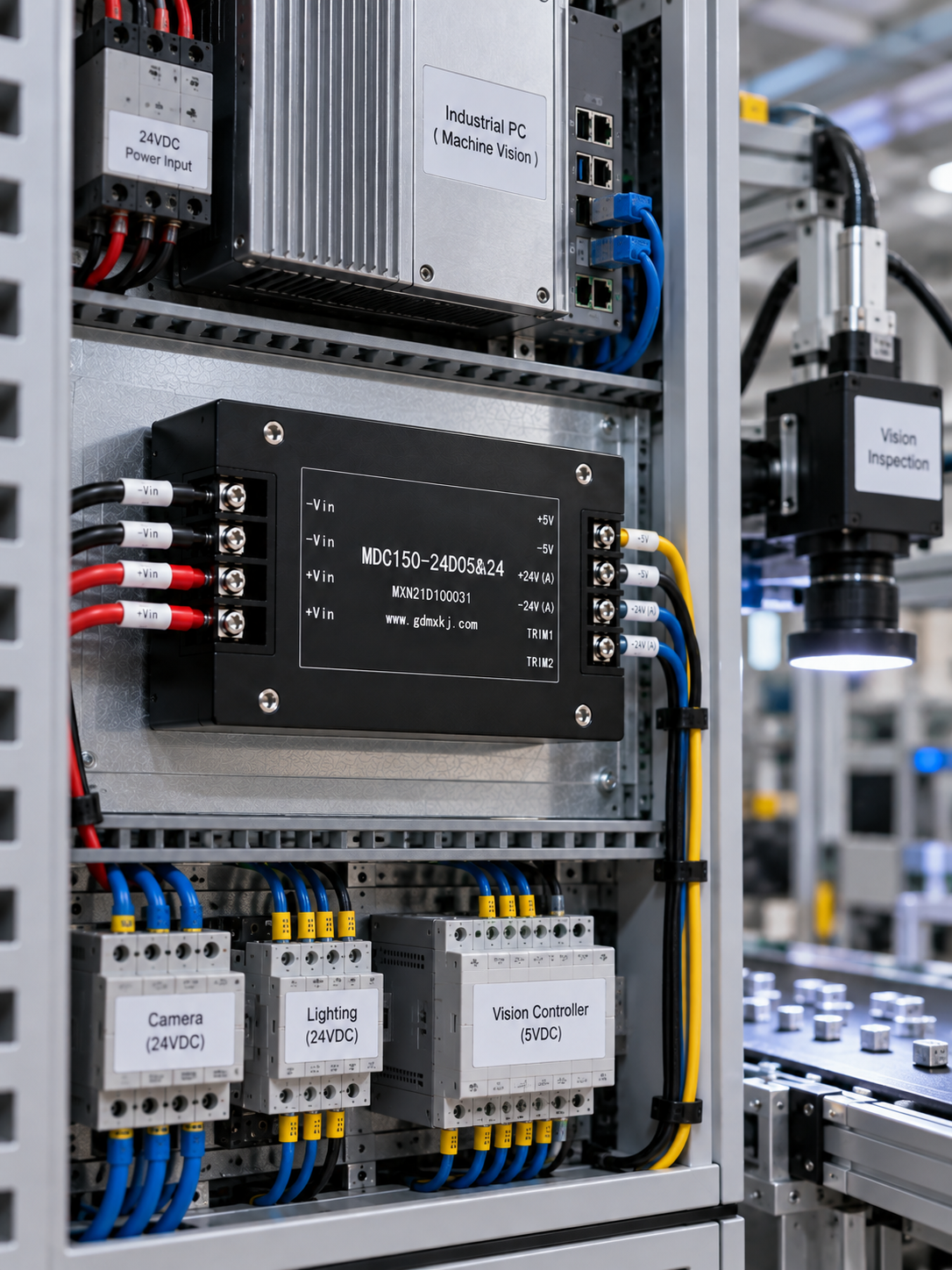
MDC150-24D05&A24 Dual-Output Isolated DC-DC Converter for Machine Vision 5V & 24V Power
Why Do Machine Vision Systems Need Both 5V and 24V Auxiliary Power?
A machine vision system rarely operates from only one voltage rail.
In a typical vision inspection machine, the main control cabinet may already have a 24VDC industrial bus, while different devices inside the system require different operating voltages.
For example:
Industrial cameras may require 24VDC;
Vision lighting and lighting controllers may use 24VDC;
Sensors and I/O devices commonly operate from 24VDC;
Vision controllers, data acquisition electronics and embedded control boards may require 5VDC.
This creates a practical power design question for machine builders:
How can both 5V and 24V auxiliary loads be powered from the same industrial DC bus without adding unnecessary power modules and wiring?
This is the type of application the MDC150-24D05&A24 dual-output isolated DC-DC converter is designed to address.
One Machine Vision System, Multiple Power Requirements
Look inside a modern machine vision control cabinet and you may find several different types of loads operating simultaneously.
On the 24V side, there may be:
Industrial cameras, vision lighting, sensors, I/O devices and other field equipment.
On the 5V side, there may be:
Vision control electronics, data acquisition modules, embedded controllers and low-voltage digital circuits.
Using separate DC-DC converters for each voltage rail can increase the number of components, connection points and wiring paths inside the cabinet.
For compact inspection machines and automation equipment, this can make the auxiliary power architecture unnecessarily complicated.
MDC150-24D05&A24 — Two Auxiliary Power Rails from One Module
The MDC150-24D05&A24 uses a dual-output architecture.
The benefit is not simply having “one more output.”
It allows machine builders to derive two auxiliary voltage rails from the industrial DC power architecture using one DC-DC module.
A typical machine vision power structure can therefore be simplified to:
24VDC Industrial Bus → MDC150-24D05&A24 → 5V Loads + 24V Loads
The 5V rail can support low-voltage control and data-processing electronics, while the 24V rail can support cameras, lighting and other industrial loads.
For machine vision systems, AOI equipment and automated inspection machines, this can provide a cleaner and more centralized auxiliary power architecture.
Why Is Galvanic Isolation Important in Machine Vision Equipment?
Machine vision systems do not operate in electrically quiet environments.
Inside or around an automation cabinet, there may also be:
Servo drives;
Motors;
Relays;
Switching power supplies;
High-frequency lighting controllers;
Industrial communication devices;
Sensors and I/O modules.
These devices can introduce electrical noise and transient disturbances into the system.
At the same time, cameras, vision controllers, data acquisition electronics and communication circuits depend on stable power.
The MDC150-24D05&A24 therefore uses galvanic isolation between the input and output, helping establish an electrical boundary between the upstream DC bus and downstream auxiliary loads.
For industrial equipment designers, isolation is more than a specification on a datasheet.
It is part of building a more controlled power architecture around sensitive electronic loads.
Camera Dropouts Are Not Always Camera Problems
When a machine vision system experiences:
Camera dropouts, missing image frames, controller resets, unstable sensor triggering, intermittent communication faults or inconsistent inspection results,
engineers often begin troubleshooting the camera, network connection or software.
But auxiliary power should also be checked.
Motor switching, sudden load changes and electrical interference inside the cabinet can affect low-voltage electronics if the auxiliary power architecture is not designed appropriately.
For machine vision systems expected to operate continuously on production lines, power stability should therefore be considered during the system design stage—not only after intermittent problems appear.
How Can Dual Outputs Simplify the Control Cabinet?
A conventional auxiliary power architecture may require:
24V Bus → DC-DC Converter A → 5V
24V Bus → DC-DC Converter B → Isolated 24V
With the MDC150-24D05&A24, these two auxiliary power requirements can be integrated into a single dual-output DC-DC module.
For OEMs and machine builders, this can help reduce:
The number of separate power modules;
Cabinet space requirements;
Internal wiring;
Power components in the BOM;
Overall system integration complexity.
This becomes particularly useful in compact industrial equipment where every component and wiring path inside the cabinet matters.
Typical Applications
The MDC150-24D05&A24 is suitable for equipment that combines an industrial DC bus with multiple auxiliary voltage requirements, including:
Machine vision inspection systems, AOI equipment, industrial camera systems, automated inspection machines, smart manufacturing equipment, robotic vision systems, vision sorting machines and OEM automation equipment.
It is particularly relevant where 5V control electronics and 24V industrial loads need to operate within the same system.
Why Can We Do It?
Industrial DC-DC conversion is not only about converting one voltage into another.
The real challenge is maintaining reliable auxiliary power inside demanding industrial equipment.
The MDC series is designed around practical industrial operating conditions.
Galvanic Isolation
Electrical isolation separates the upstream DC bus from downstream auxiliary loads, supporting applications where power-domain separation and noise immunity are important.
Potted Construction
The internal structure is potted to improve mechanical stability and help the module withstand vibration, dust and demanding industrial environments.
EMI/EMC-Oriented Design
The power architecture takes the complex electromagnetic environment inside industrial control cabinets into consideration, helping reduce unwanted interaction between the converter and surrounding electronics.
Dynamic Load Response
Cameras, controllers and other electronic loads do not always operate at constant power. The converter is designed to respond to load changes encountered during real equipment operation.
Protection Functions
Protection against abnormal operating conditions, including overvoltage, overcurrent, short circuit and overtemperature, helps improve system reliability.
OEM / ODM Capability
Input range, output parameters, interface, mounting structure and thermal design can be adapted according to specific equipment and project requirements.
It Is Not Just About Adding Another Power Supply
When selecting a DC-DC converter for machine vision equipment, the question should not only be:
“Can it provide 5V?”
or
“Can it provide 24V?”
A more useful question is:
Can the power architecture be made simpler, more stable and easier to integrate into production equipment?
That is where the MDC150-24D05&A24 dual-output architecture provides value.
By deriving two auxiliary power rails from a common industrial DC bus through one isolated DC-DC module, OEMs, automation equipment manufacturers and system integrators can reduce unnecessary power conversion hardware while creating a clearer auxiliary power structure.
For applications that need to power both low-voltage vision control electronics and 24V cameras, lighting or field devices, the MDC150-24D05&A24 provides a practical approach to auxiliary power integration.