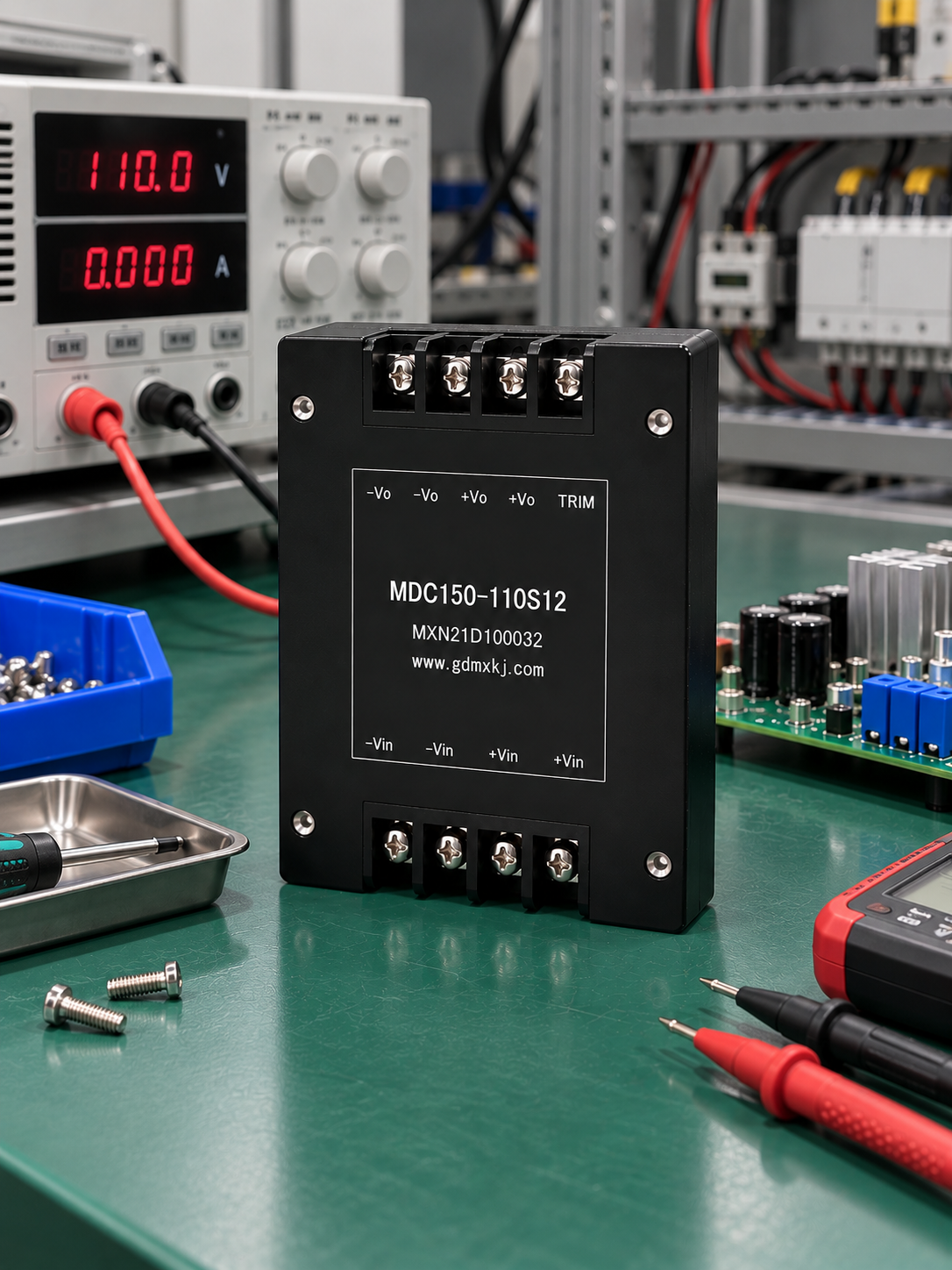
150W 110V to 12V Isolated DC-DC Converter for Railway and Industrial Control Systems | MDC150-110S12
Why Can a 110V DC Auxiliary Bus Cause Unstable 12V Power in Railway and Industrial Control Systems?
In railway equipment and industrial control systems, a nominal 110V DC auxiliary bus does not always remain at exactly 110V.
Input voltage can change with battery condition, charging status, load switching and system operating conditions.
For sensitive 12V loads, these variations can contribute to problems such as:
Controller resets;
Unstable communication equipment;
Sensor or monitoring system interruptions;
Unexpected shutdowns during voltage fluctuation;
Electrical noise affecting low-voltage electronics.
This is why converting a 110V DC bus to 12V is not simply a matter of reducing voltage.
The auxiliary power stage also needs to provide stable conversion and electrical isolation between the upstream DC bus and downstream electronics.
The MINGZINC MDC150-110S12 is designed for this type of application.
MDC150-110S12
— 150W Isolated 110V to 12V DC-DC Converter
The MDC150-110S12 converts a wide 66–154VDC input into a regulated 12VDC output, providing up to 150W of power.
Key Specifications
Model: MDC150-110S12
Rated Power: 150W
Input Voltage: 66–154VDC
Nominal Input: 110VDC
Output Voltage: 12VDC
Output Current: Up to 12.5A
Conversion Type: Isolated DC-DC
Cooling: Natural cooling
Construction: Industrial enclosed module
The wide input range allows the converter to continue supplying the 12V load when the upstream 110V DC bus moves above or below its nominal voltage.
Why Does a Wide 66–154VDC Input Range Matter?
A 110V DC bus may be supplied by batteries, chargers, rectifiers or other DC distribution equipment.
Its actual operating voltage can therefore vary considerably.
A converter designed around a narrow input range may reach its operating limits when the bus voltage changes, potentially affecting the downstream 12V equipment.
The 66–154VDC input range of the MDC150-110S12 gives engineers greater operating margin around a nominal 110V system.
This makes it suitable for auxiliary loads that need consistent 12V power even when the upstream DC bus is not perfectly stable.
H2: Why Is Galvanic Isolation Important?
In complex railway and industrial electrical systems, power lines often coexist with switching equipment, motors, relays, communication devices and control electronics.
Electrical disturbances on the main DC bus should not be allowed to propagate easily into sensitive low-voltage loads.
The MDC150-110S12 uses galvanic isolation between input and output.
This helps separate the 110V-side power domain from the 12V-side electronics and can support a cleaner, more robust auxiliary power architecture.
For system designers, isolation is particularly useful when supplying:
Control electronics;
Communication modules;
Monitoring devices;
Sensors;
Embedded computers;
Auxiliary electronic equipment.
One 150W Power Stage for Multiple 12V Auxiliary Loads
Not every application needs a separate converter for each small 12V load.
With up to 150W / 12.5A output, the MDC150-110S12 can support a centralized 12V auxiliary power architecture where appropriate.
For example, one converter may provide power for several low-voltage devices within the same subsystem, depending on their total load and startup requirements.
This can help simplify system wiring, reduce the number of individual power modules and make the auxiliary power architecture easier to manage.
Designed for Industrial Operating Environments
A DC-DC converter installed in railway or industrial equipment must deal with more than nominal voltage specifications.
Long-term operation may involve electrical noise, load changes, vibration, temperature variation and demanding installation environments.
The MDC150-110S12 is designed as an industrial DC-DC power module, with attention to:
Wide input operation
Supports 66–154VDC input around a nominal 110V DC bus.
Galvanic isolation
Separates the input and output power domains.
Stable 12V output
Provides regulated low-voltage power for downstream electronics.
Low-ripple design
Helps provide cleaner DC power for sensitive electronic loads.
Fast dynamic response
Supports output stability when downstream load conditions change.
Industrial protection design
Supports protection functions such as input undervoltage, output overvoltage, overcurrent, short circuit and overtemperature protection.
Why We Can Do It
For an industrial power module, reliability is not determined by one specification alone.
It depends on how the complete power stage is designed and manufactured.
For the MDC series, we focus on several areas:
Component Selection
Key power components are selected according to voltage, current and thermal operating requirements rather than only nominal operating conditions.
Isolation Design
The input and output stages are electrically isolated to support applications where separation between the high-voltage DC bus and low-voltage electronics is required.
EMI/EMC-Oriented Design
PCB layout, filtering and power-stage design are considered together to reduce the impact of switching noise in industrial electrical environments.
Thermal Management
The enclosure and internal thermal path are designed to transfer heat away from critical components during continuous operation.
Potting and Mechanical Protection
The module construction helps improve resistance to environmental and mechanical stresses encountered in industrial applications.
Production Testing and Quality Control
Electrical performance and protection functions are checked during production to help maintain consistency between units.
The goal is not simply to convert 110VDC to 12VDC, but to provide a stable power stage that can become part of a reliable industrial system.
Typical Applications of MDC150-110S12
The MDC150-110S12 is suitable for systems using a nominal 110V DC bus that require an isolated 12V auxiliary supply.
Typical applications include:
Railway communication equipment;
Railway auxiliary electronics;
Railway monitoring systems;
Industrial control systems;
Power distribution automation;
Battery-powered control systems;
Communication equipment;
Monitoring and data acquisition equipment;
Embedded controllers;
Industrial auxiliary power systems.
OEM & ODM Support for Different Power Architectures
Different projects may use different battery voltages, output requirements, installation methods and interface configurations.
MINGZINC supports OEM and ODM power supply development for industrial applications.
Customization can include input voltage range, output voltage, power level, mechanical structure, terminal/interface configuration, cooling design and other project-specific requirements.
For distributors, system integrators and equipment manufacturers, this makes it possible to select a standard platform first and then adapt the power solution to the actual system architecture when necessary.
Looking for a 110V to 12V Industrial DC-DC Converter?
If your system uses a 110V nominal DC bus and requires a stable, isolated 12V auxiliary power supply, the MDC150-110S12 provides:
66–154VDC wide input + 12VDC output + 150W power + galvanic isolation.
It is designed for industrial and railway auxiliary power applications where input variation, electrical isolation and long-term power stability need to be considered together.
For project evaluation, you can provide us with your input voltage range, required output voltage/current, load type and operating environment.
We can help determine whether the MDC150-110S12 is suitable or whether a customized DC-DC power solution is required.
MINGZINC — Industrial Power Solutions for Demanding Applications.