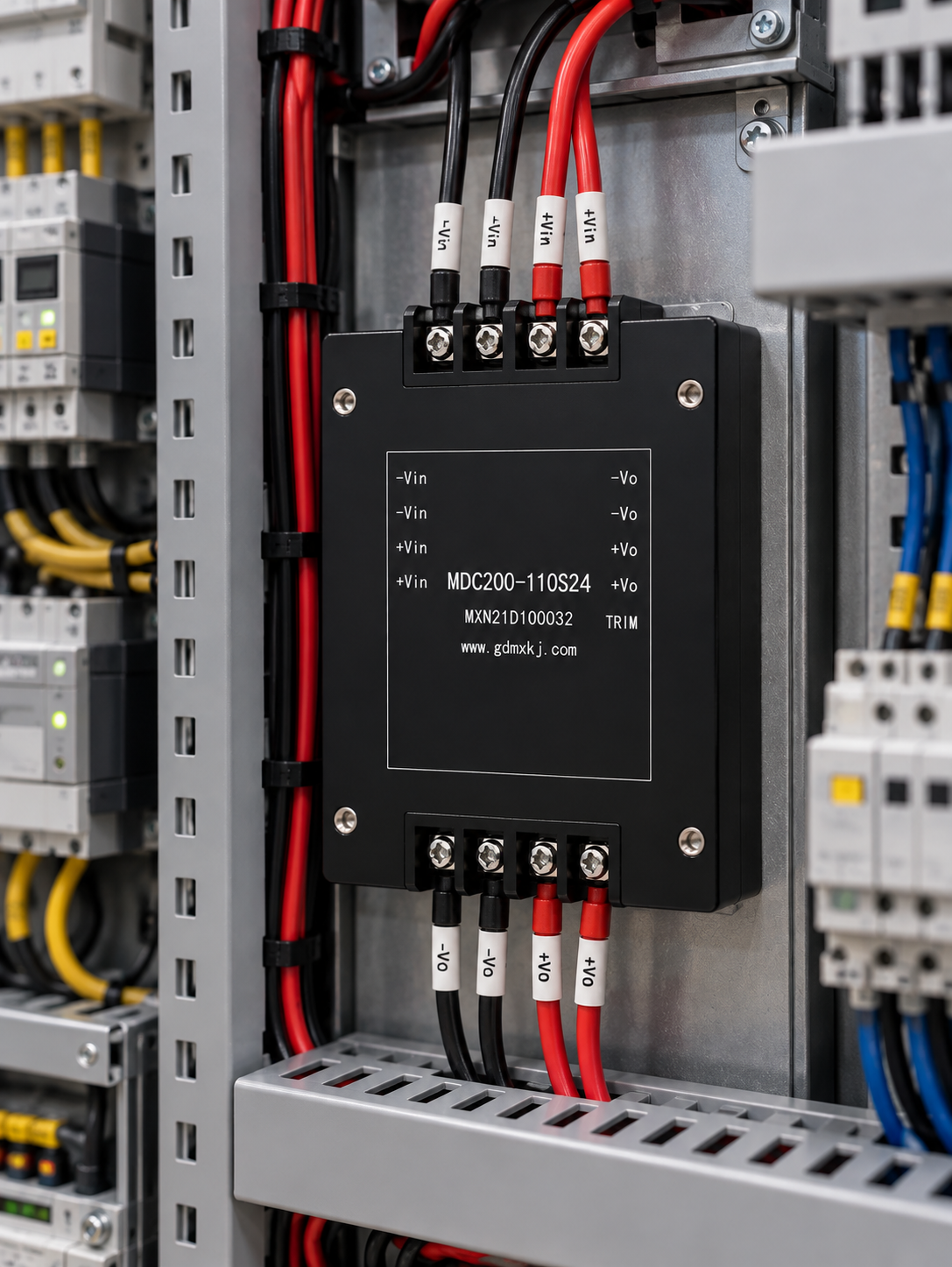
MDC200-110S24 200W Isolated DC-DC Converter for 110VDC to 24V Industrial Auxiliary Power
Why Do 110VDC Systems Still Need an Isolated 24V Auxiliary Power Supply?
In industrial control, power distribution automation and communication systems, a 110VDC bus may be used as the main DC power source.
But many devices inside the system cannot operate directly from 110VDC.
PLCs, I/O modules, relays, sensors, communication units and other control electronics commonly require a stable 24VDC auxiliary supply.
This means that what appears to be a simple 110VDC-to-24VDC conversion can directly affect the stability of the entire control system.
This is where the MDC200-110S24 is designed to fit.
The Challenge Is More Than Stepping 110V Down to 24V
A real industrial control cabinet is very different from a laboratory power environment.
The DC bus may be exposed to:
Input voltage fluctuations;
Switching transients;
Electrical noise from relays, contactors and motors;
Ground potential differences between subsystems;
Rapid load changes;
Elevated cabinet temperatures during continuous operation.
If the 24V auxiliary supply becomes unstable, downstream equipment may experience:
PLC or controller resets, unstable relay operation, sensor abnormalities, I/O faults or intermittent communication interruptions.
For an industrial equipment manufacturer, therefore, the real question is not simply:
“Can we get 24VDC?”
The more important question is:
“Can the 24VDC remain stable in a demanding industrial environment?”
MDC200-110S24
— Isolated 24V Auxiliary Power from a 110V-Class DC Bus
The MDC200-110S24 is a 200W isolated DC-DC converter designed for industrial auxiliary power applications.
It converts a 110V-class DC input into 24VDC output, creating a separate low-voltage power layer for control and auxiliary equipment.
Key Configuration
Model: MDC200-110S24
Rated Power: 200W
Output Voltage: 24VDC
Conversion Type: Isolated DC-DC
This architecture allows the main DC bus and the low-voltage control side to be separated more clearly within the overall power system.
For equipment designed for long-term industrial operation, this separation can be particularly important.
Why Does Galvanic Isolation Matter?
In an industrial system, isolation is not only about converting one voltage level into another.
Galvanic isolation electrically separates the input side from the 24V output side.
This helps reduce interaction between different power domains and provides a more independent low-voltage supply environment for sensitive control electronics.
This becomes particularly relevant when the 24V rail supplies devices such as:
PLCs;
Remote I/O modules;
Relays;
Sensors;
Communication modules;
Industrial controllers.
The stability of the auxiliary power rail can directly influence the reliability of the control chain.
For a 110VDC bus system, the architecture can therefore be simplified as:
110V-Class DC Bus → Isolated DC-DC Converter → 24VDC Control Power
What Does 200W Mean Inside a Control Cabinet?
A 24V auxiliary rail in an industrial cabinet often powers more than one device.
The same power supply may need to support a combination of:
PLC + I/O modules + relays + sensors + communication electronics + other auxiliary loads.
This means power selection should not be based only on normal operating consumption.
Engineers also need to consider startup conditions, dynamic load changes and sufficient system power margin.
With 200W rated power, the MDC200-110S24 can support a broader group of 24V auxiliary loads rather than serving only a small control board.
For OEM equipment manufacturers and system integrators, this can also help simplify the internal auxiliary power architecture.
Why We Can Do It
The MDC200-110S24 is not designed simply to reduce the input voltage to 24V.
The design focus is to provide a DC-DC power module suitable for integration into real industrial equipment.
1. Isolated Power Architecture
The isolated topology separates the input and output power domains, allowing the 110V-class DC bus and 24V control electronics to operate with electrical isolation between them.
2. Design for Industrial EMI/EMC Environments
Inside an industrial cabinet, power converters may operate alongside switching devices, relays, communication lines, controllers and multiple voltage levels.
The power module therefore needs to be designed with the surrounding electromagnetic environment in mind, rather than focusing only on voltage conversion.
3. Stable Output Under Changing Loads
PLCs, relays, I/O modules and communication equipment do not always draw constant power.
Their operating states change continuously.
A suitable auxiliary power converter must maintain stable output during load transitions to reduce the risk of disturbances reaching downstream control electronics.
4. Industrial Protection Design
Industrial equipment may encounter abnormal input, output or thermal conditions during operation.
Protection functions can be configured according to project requirements to improve power-system reliability and reduce the risk of secondary damage.
5. OEM / ODM Adaptation
Not every industrial system uses exactly the same DC bus, installation method, interface or thermal design.
MINGZINC can support project-specific adaptation of:
input range, output parameters, electrical interface, mounting method and thermal solution.
The objective is to make the power module fit the equipment architecture—not force the equipment architecture to fit a standard converter.
Where Can the MDC200-110S24 Be Used?
The MDC200-110S24 is suitable for industrial systems where a 110V-class DC bus needs to supply 24V control or auxiliary loads.
Typical applications include:
Industrial Control Cabinets
Converting the DC bus to 24VDC for PLCs, relays, I/O modules, sensors and other control devices.
Power Distribution Automation
Providing isolated 24V auxiliary power for controllers, communication units and monitoring electronics.
Industrial Communication Systems
Supplying communication controllers, industrial interfaces and other 24V electronic loads.
Power and Industrial Equipment
Creating a low-voltage auxiliary power rail from an existing DC bus for monitoring and control systems.
OEM Industrial Equipment
Suitable for machines and systems that already contain a higher-voltage DC bus but require 24VDC for internal control electronics.
For OEMs, System Stability Matters More Than the Voltage Label
When selecting a DC-DC converter, comparing only:
200W + 110V + 24V
does not tell the whole story.
OEMs, system integrators and industrial equipment manufacturers should also consider:
Can the 24V output remain stable when the input bus fluctuates?
How does the converter respond to rapid load changes?
Will electrical noise inside the cabinet affect downstream control equipment?
Can the converter operate reliably under continuous industrial conditions?
Does the system require galvanic isolation?
Can the mechanical interface and mounting method fit the existing equipment?
These factors affect more than the power module itself.
They can influence equipment uptime, field reliability and maintenance requirements.
One DC-DC Converter Between Two Power Domains
In a 110VDC system, the main DC bus provides the system's primary energy.
The 24V auxiliary rail supports the functions that keep the equipment operating:
control, sensing, communication and actuation.
The MDC200-110S24 sits between these two power domains:
110V-Class DC Bus
↓
MDC200-110S24 Isolated DC-DC Converter
↓
24VDC Auxiliary Power
↓
PLC / I/O / Relay / Sensor / Communication Module
Its role is therefore not simply to step down voltage.
It provides a stable and isolated 24V auxiliary power layer between the main DC bus and the industrial control system.
Looking for a 110VDC to 24VDC Power Solution?
If your equipment uses a 110V-class DC bus and requires 24VDC auxiliary power for PLCs, I/O modules, relays, sensors or communication electronics, the MDC200-110S24 can be evaluated as an isolated DC-DC power solution.
MINGZINC supports OEM/ODM adaptation for project-specific input ranges, output parameters, interfaces, mounting methods and thermal requirements.