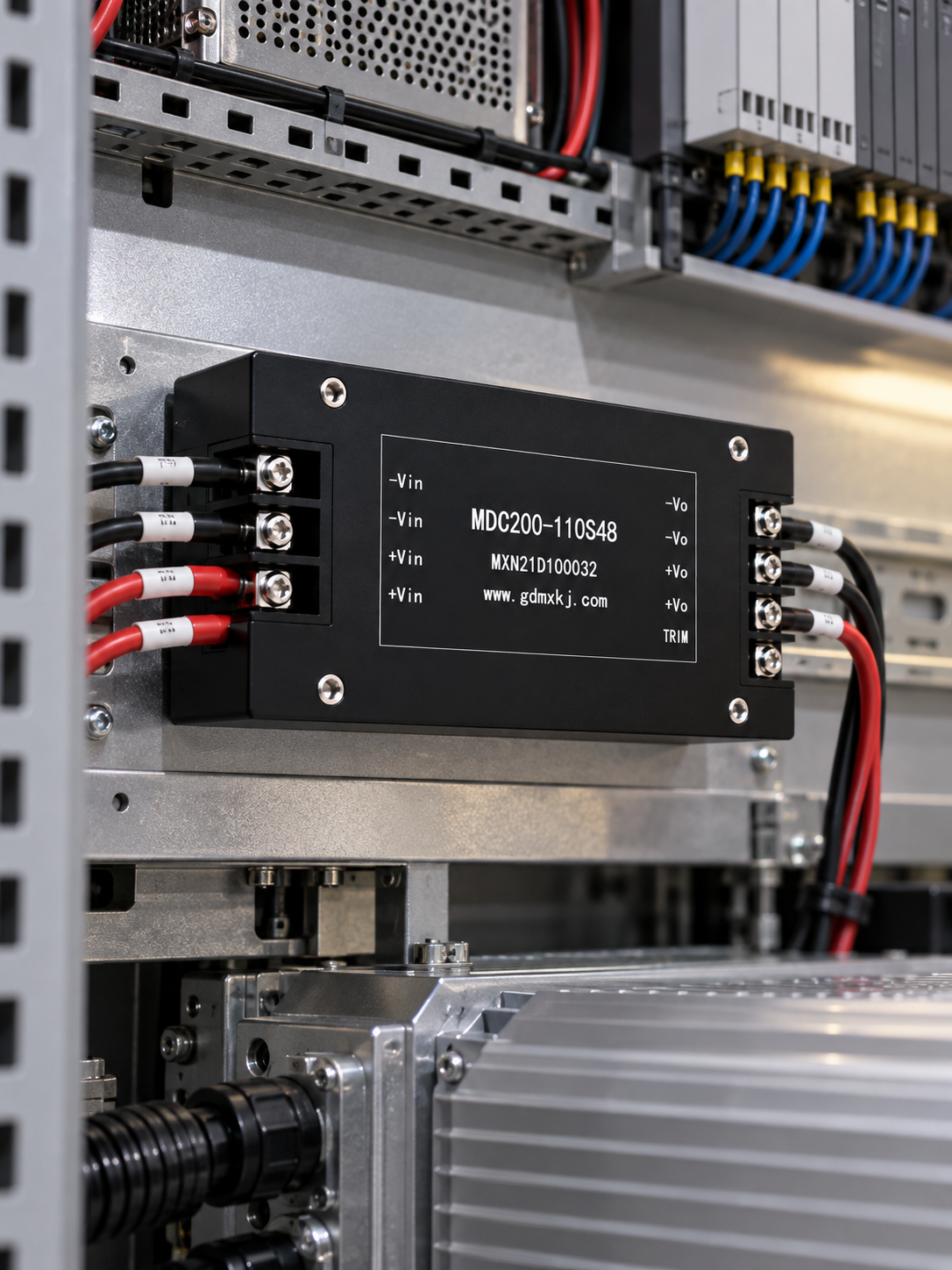
MDC200-110S48 200W Isolated 110V to 48V DC-DC Converter for Industrial Communication Systems
Why Does a 110VDC Industrial System Still Need a Separate 48V Auxiliary Power Supply?
In power automation, industrial communication and large control systems, a 110V-class DC bus may already serve as the main DC power source.
But the communication and control layer often operates at a different voltage.
Industrial networking equipment, communication units, remote monitoring devices and other electronics may require a stable 48VDC auxiliary supply.
This creates a separate power path inside the system:
110V-Class DC Bus → 48VDC Auxiliary Power → Communication & Control Equipment
The challenge is not simply stepping 110V down to 48V.
The more important question is:
How can the 48V equipment be supplied reliably while reducing the influence of disturbances from the main DC bus?
This is where the MDC200-110S48 is designed to fit.
Why Can 48V Communication Equipment Be Affected by Upstream Power?
A real industrial control cabinet is not a clean laboratory power environment.
Inside the same cabinet, there may be:
Relays, contactors, controllers, communication equipment, power modules and other switching loads.
As these devices switch or their loads change, the DC bus can experience voltage fluctuations and electrical disturbances.
If the auxiliary power supply cannot maintain stable output, downstream equipment may experience:
Unexpected communication-device resets;
Intermittent network interruptions;
Controller disconnections;
Unstable data transmission;
Remote monitoring abnormalities;
Difficult-to-reproduce intermittent faults.
These symptoms may initially look like communication or network problems.
But before investigating switches, communication protocols or software, the auxiliary power source is also worth checking.
MDC200-110S48 — Converting a 110V-Class DC Bus to Isolated 48VDC
The MDC200-110S48 is a 200W isolated DC-DC converter designed to convert a 110V-class DC input into 48VDC output.
Key Configuration
Model: MDC200-110S48
Rated Power: 200W
Output Voltage: 48VDC
Conversion Type: Isolated DC-DC
Within the system, the power architecture can be arranged as:
110V-Class DC Bus
↓
MDC200-110S48
↓
Isolated 48VDC
↓
Industrial Communication / Network / Control Equipment
The purpose is not only to obtain a different voltage level.
It is also to establish a more independent 48V auxiliary power domain for downstream equipment.
Why Does Galvanic Isolation Matter Here?
Industrial systems often contain several different power domains.
The main DC bus supplies system energy, while communication and control equipment belongs to a more sensitive electronic layer.
Without appropriate separation between these power domains, disturbances on the main bus and potential differences between subsystems can increase uncertainty at the downstream equipment.
The MDC200-110S48 uses an isolated input-to-output power architecture.
Its role is therefore not simply:
110V → 48V
It also creates electrical separation between the:
Main DC Bus
and the
48V Communication / Control Power Domain
For industrial equipment expected to operate continuously over long periods, this separation can be an important part of the overall power architecture.
Why 48V Instead of 24V?
24VDC is widely used for PLCs, sensors, I/O modules and relays.
48VDC is commonly associated with another group of loads, including certain:
industrial communication devices, networking equipment, communication control units and remote monitoring systems.
This is why the MDC200-110S48 and MDC200-110S24, although based on a similar power platform, are intended for different downstream power requirements.
For a system dominated by:
PLC + I/O + Sensors + Relays
24VDC may be the typical auxiliary voltage.
When the system contains:
Industrial Communication + Network Equipment + Remote Monitoring
requiring 48VDC, a dedicated 48V auxiliary power architecture needs to be considered.
What Does 200W Mean in a Real Industrial System?
A 48V auxiliary rail inside industrial equipment may supply more than one load.
Several devices can share the same 48V power source.
Therefore, DC-DC converter selection should consider more than normal operating consumption.
Engineers may also need to evaluate:
Multiple loads operating simultaneously;
Startup power requirements;
Dynamic load changes;
Continuous operation;
Adequate system power margin.
With 200W rated power, the MDC200-110S48 can support a group of 48V auxiliary loads rather than being limited to a single low-power electronic board.
For OEM equipment manufacturers, this can also help simplify the internal power architecture and reduce the need for multiple smaller conversion modules.
Why We Can Do It
Industrial DC-DC reliability is not determined by one specification alone.
For the MDC200-110S48, the design focus is the stability of the complete power path from the DC input to the 48V auxiliary output under real industrial operating conditions.
1. Isolated Power Architecture
Electrical isolation between input and output separates the 110V-class main DC bus from the 48V auxiliary power domain.
2. Designed for Industrial EMI/EMC Environments
Industrial cabinets can contain switching devices, relays, communication lines, controllers and multiple voltage levels within a confined space.
The DC-DC converter therefore needs to account for the surrounding electromagnetic environment rather than simply performing voltage conversion under ideal conditions.
3. Response to Dynamic Loads
Communication and control equipment do not always draw constant power.
As downstream equipment changes operating states, the converter needs to respond to load changes while maintaining stable output.
4. Industrial Protection Design
Protection strategies for input, output and thermal conditions can be configured according to project requirements, helping improve system reliability under abnormal operating conditions.
5. OEM / ODM Adaptation
Different industrial systems may use different DC bus conditions, interfaces, mounting arrangements and thermal structures.
MINGZINC can support project-specific adaptation of:
input range, output parameters, electrical interface, mounting method and thermal solution.
The goal is to make the power module fit the customer's equipment architecture—not force the equipment architecture to fit a standard converter.
Where Can the MDC200-110S48 Be Used?
Based on its combination of 110V-class DC input, 48VDC output, 200W power and galvanic isolation, the MDC200-110S48 is suitable for several types of industrial auxiliary power applications.
Industrial Communication Systems
Creates a dedicated 48V power rail from the system DC bus for industrial communication and related electronic equipment.
Power Distribution Automation
Provides isolated 48V auxiliary power for communication, monitoring and control electronics in systems using a 110V-class DC bus.
Industrial Control Cabinets
Where a higher-voltage DC bus and 48V communication equipment coexist inside the same cabinet, an isolated DC-DC converter can create a separate auxiliary power domain.
Remote Monitoring and Communication Equipment
Provides 48VDC auxiliary power for communication, data transmission and remote monitoring electronics.
OEM Industrial Equipment
Suitable for OEM systems that already contain a 110V-class DC bus but require a separate 48VDC auxiliary power source for internal equipment.
Selecting a 110V-to-48V DC-DC Converter Is About More Than “200W”
During engineering selection or procurement, it is easy to reduce a converter to three numbers:
110V + 48V + 200W
But for industrial equipment expected to operate continuously, engineers and buyers should also consider:
Can the 48V output remain stable when the DC bus fluctuates?
How does the converter respond when downstream loads change rapidly?
Does the application require galvanic isolation?
How will the converter behave in the cabinet's EMI/EMC environment?
Is it suitable for continuous industrial operation?
Can the mechanical interface and mounting arrangement fit the existing system?
Can electrical parameters be adapted for the project?
These factors affect more than the DC-DC converter itself.
They can influence the equipment's operating stability, field reliability and maintenance requirements.
One DC-DC Converter Between Two Power Domains
The role of the MDC200-110S48 can be summarized simply:
110V-Class Main DC Bus
↓
Isolation + Voltage Conversion
↓
Stable 48V Auxiliary Power
↓
Industrial Communication / Network / Control Equipment
Its purpose is not merely to step down voltage.
More importantly, it establishes a stable and isolated auxiliary power layer between the main DC bus and downstream 48V equipment.
That is the role an industrial DC-DC converter should perform inside the system.
Looking for a 110VDC to 48VDC Industrial Power Solution?
If your equipment already uses a 110V-class DC bus and requires an independent 48VDC auxiliary supply for industrial communication, networking, remote monitoring or other 48V equipment, the MDC200-110S48 can be evaluated for your power architecture.
MINGZINC supports OEM/ODM projects with adaptation of input range, output parameters, electrical interfaces, mounting structure and thermal solutions.