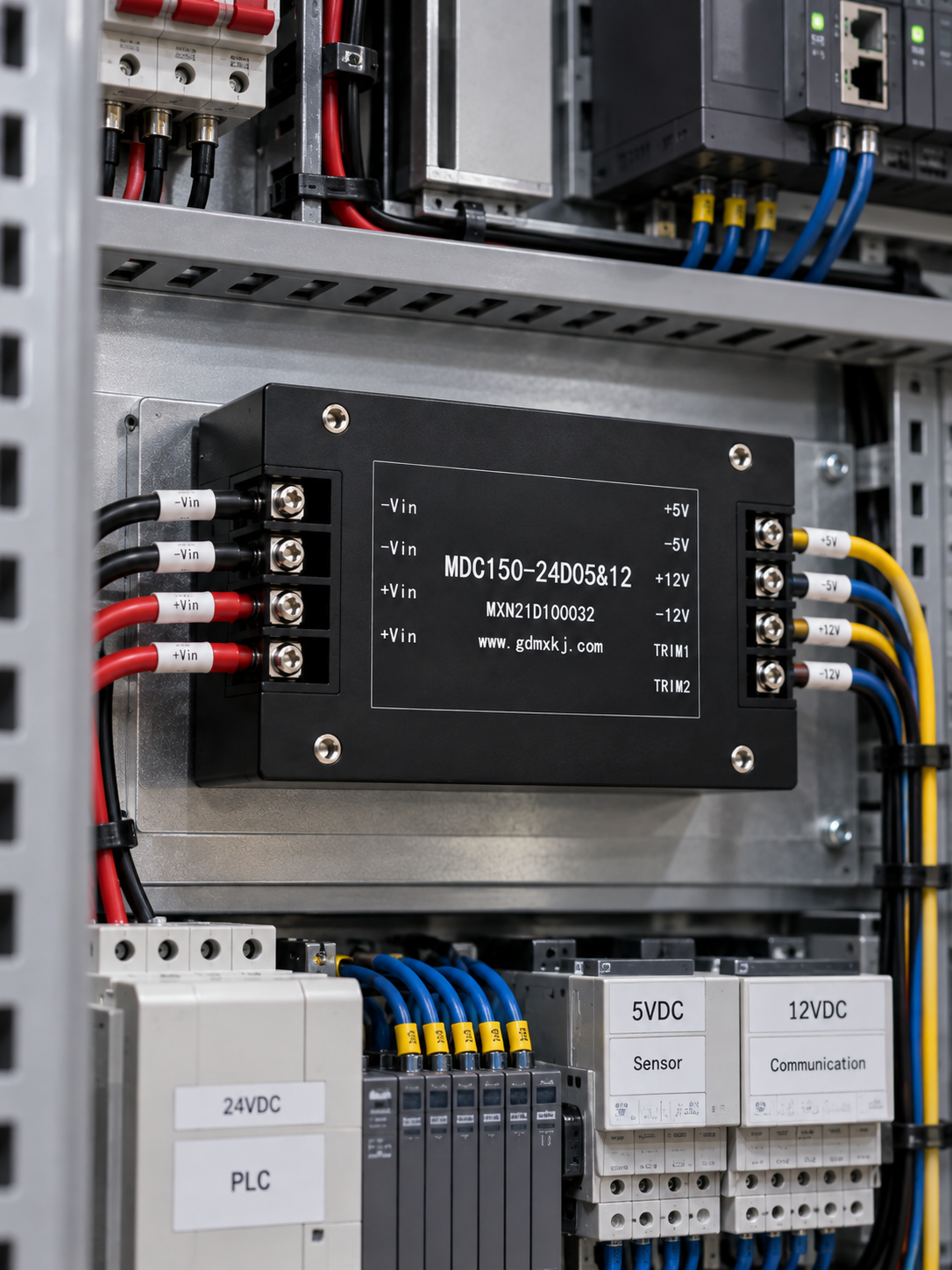
MDC150-24D05&12 150W Isolated 24V to 5V/12V Dual Output DC-DC Converter
Your Industrial System Has a 24V DC Bus — But What If It Also Needs Both 5V and 12V?
24VDC is one of the most common power buses used in industrial automation systems.
But not every device inside a control cabinet operates directly from 24V.
A typical industrial system may include:
PLC and I/O systems;
Industrial communication modules;
Embedded control boards;
Sensors and signal-processing circuits;
Displays and human-machine interfaces;
Other auxiliary electronics requiring 5V or 12V.
This creates a common power design challenge:
How do you efficiently generate both 5V and 12V from the same 24V industrial DC bus?
Using separate DC-DC converters for each voltage rail is possible, but it also means more components, more wiring and more installation space.
The MINGZINC MDC150-24D05&12 is designed for exactly this type of auxiliary power architecture.
One 24V Input, Two Auxiliary Output Rails
The MDC150-24D05&12 is a 150W isolated dual-output DC-DC converter designed to provide two low-voltage power rails from a 24V-class industrial DC source.
Its basic power architecture is:
24VDC Input → 5VDC + 12VDC Dual Output
This allows a single DC-DC power module to support different auxiliary loads within the same industrial system.
For example:
5VDC can supply embedded control electronics, digital circuits, sensor interfaces or other low-voltage boards.
12VDC can supply communication devices, controllers, displays and other 12V auxiliary loads.
Instead of installing separate converters for each voltage rail, the dual-output architecture helps centralize the auxiliary power design.
Why Does Isolation Matter in an Industrial Control Cabinet?
A 24V industrial DC bus does not always operate in a clean electrical environment.
Motors, relays, contactors, drives and switching devices can introduce electrical noise and transient disturbances into the system.
For sensitive low-voltage electronics, unstable auxiliary power may contribute to problems such as:
Unexpected controller resets;
Unstable sensor signals;
Intermittent communication faults;
Data acquisition errors;
I/O abnormalities;
Unexplained system interruptions.
The MDC150-24D05&12 uses galvanic isolation between the input and output sides, creating an electrical boundary between the main 24V bus and the low-voltage auxiliary loads.
For industrial equipment designed for continuous operation, a DC-DC converter is therefore doing more than simply stepping down voltage.
It also becomes part of the system's power-domain architecture.
Simplifying 5V and 12V Auxiliary Power Architecture
The advantage of a dual-output converter is not simply having “one more output.”
Its real value is system simplification.
A conventional architecture may require:
24V Bus → DC-DC Converter #1 → 5V
24V Bus → DC-DC Converter #2 → 12V
With the MDC150-24D05&12, the architecture can be simplified to:
24V Bus → MDC150-24D05&12 → 5V + 12V
For OEM equipment manufacturers and system integrators, this can help reduce the number of independent power modules required inside the equipment.
It can also simplify wiring, installation and overall power-system integration.
When the same machine platform is produced repeatedly, reducing unnecessary power components can also make assembly and maintenance more straightforward.
150W Power for Multi-Load Industrial Systems
Auxiliary power rails in industrial equipment often supply more than one device.
The 5V and 12V rails may each support several loads.
Typical 5V loads can include:
Control boards, MCU/FPGA peripheral circuits, signal-processing electronics, sensor interfaces and embedded modules.
Typical 12V loads can include:
Industrial communication equipment, display modules, controllers, monitoring electronics and other auxiliary devices.
Therefore, selecting a dual-output DC-DC converter is not only about matching the required voltages.
Engineers also need to consider the total power requirement and load distribution between the two output rails.
The MDC150-24D05&12 is built on a 150W power platform for industrial systems requiring both 5V and 12V auxiliary power from a common DC source.
Why We Can Do It
Industrial DC-DC converter reliability is not determined only by the input and output voltage numbers on a datasheet.
For the MDC series, the design focuses on the conditions encountered in real industrial equipment.
Galvanic Isolation
Electrical isolation separates the input power domain from the low-voltage auxiliary side, supporting industrial systems that require clearer electrical boundaries.
Potted Construction
The internal structure is designed for improved mechanical stability and protection in demanding industrial operating environments.
EMI/EMC-Oriented Design
Industrial cabinets can contain motors, relays, communication equipment and switching electronics. The power design therefore considers electromagnetic interference and system compatibility.
Dynamic Load Response
Controllers, communication modules and other electronic loads can change operating states quickly. The power converter must respond appropriately to changing load conditions.
Protection Functions
Depending on the product configuration, protection functions can include UVP, OVP, OCP, SCP and OTP to improve system protection under abnormal operating conditions.
Production and Quality Control
Component selection, assembly, potting and electrical testing are controlled throughout production to support consistency in OEM and batch applications.
Where Can the MDC150-24D05&12 Be Used?
The MDC150-24D05&12 is particularly suitable for equipment that already uses a 24V industrial DC bus but requires both 5V and 12V auxiliary power internally.
Typical applications include:
Industrial automation control cabinets, PLC control systems, industrial robots, machine vision systems, industrial communication equipment, embedded control systems, remote I/O equipment, industrial inspection systems and OEM automation machinery.
The dual-output architecture is especially useful when designers want to reduce power-module count and simplify the internal power distribution of the equipment.
OEM/ODM Dual-Output DC-DC Power Solutions
Different industrial systems have different auxiliary power requirements.
In addition to standard products, MINGZINC supports OEM/ODM requirements involving:
Input voltage range, output voltage combinations, power configuration, electrical interfaces, mounting structure, thermal design and other project-specific parameters.
For new equipment platforms, the power solution can also be evaluated according to three key requirements:
Input DC Bus + Required Output Voltages + Load Requirement on Each Rail
This allows the DC-DC power architecture to be matched more closely to the actual equipment rather than selecting a converter based only on nominal voltage.
Looking for 5V and 12V Power from a 24V DC Bus?
If your equipment operates from a 24VDC main power bus but internally requires both 5VDC and 12VDC auxiliary power, the MDC150-24D05&12 provides an isolated dual-output approach in a single power module.
For project evaluation, send us:
Input Voltage Range + 5V Load Requirement + 12V Load Requirement + Application
We can then evaluate the appropriate DC-DC power solution for your system.