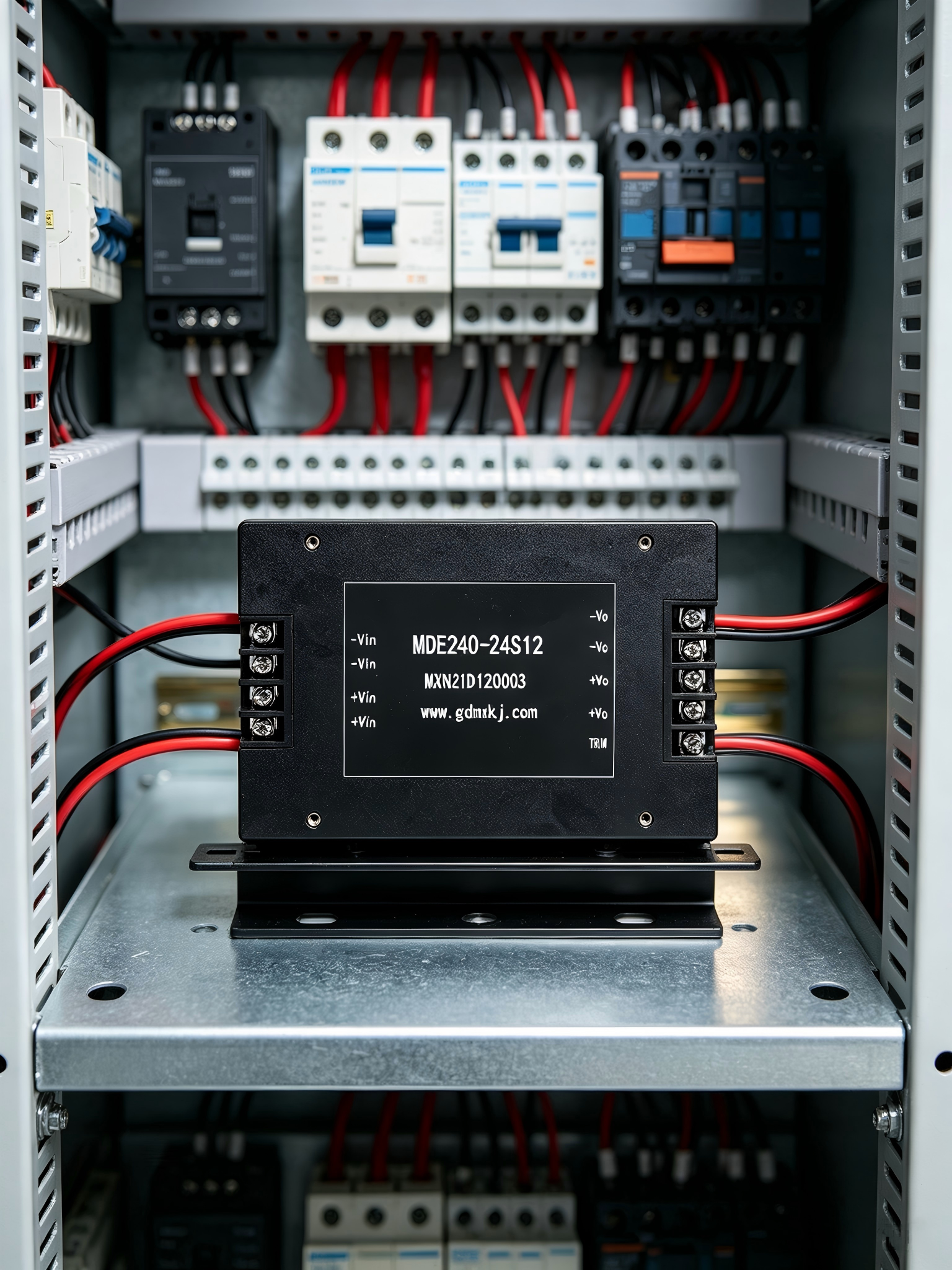
MDE240-24S12: Turning a Noisy 24V Bus Into Clean 12V Power for Your Downstream Devices
Anyone who designs industrial gear knows that 24V is everywhere inside a cabinet — PLCs, relays, sensors, comms modules all hang on that bus. The headache is the 12V loads: LED drivers, vehicle terminals, certain communication boards. Wire them straight to 24V and they fry. Add a separate supply and you waste space.
The MDE240-24S12 exists to solve exactly this wiring problem.
What goes in, what comes out
It's an isolated DC-DC module: input taps the existing 24V bus in the cabinet, output gives the downstream 12V rail. Rated at 24V input, it actually accepts anything from 18 to 36VDC. That matters, because a real 24V bus is never a clean 24V: it floats above 28V during battery charging, dips below 20V during cold cranking. The module starts up and holds regulation across the whole range.
On the output side: 12V at up to 20A, a continuous 240W. This isn't a module for one or two tiny sensors — it's built to power a whole bank of 12V loads.
How clean is the output, really
Power engineers don't judge a module by peak wattage. They look at two things: regulation and ripple.
The MDE240-24S12 holds set-point accuracy to ±2%, with line and load regulation both ±0.5%. In plain language: as the input swings from 18V to 36V and the load steps from no-load to full-load, the output meter barely moves. Ripple is 120mV peak-to-peak — invisible to digital circuits, but the difference between clean data and noisy interference for comms and analog boards.
Efficiency is 88%, which means it stays cool even at 240W. The metal case handles natural convection; no fan, no extra heatsink needed.
Why isolation matters on the floor
The worst problem on an industrial floor isn't wrong voltage — it's wrong grounding. Potential differences between devices, surges and spikes riding the bus, and a shared ground can corrupt data or fry boards.
This module provides >1500VDC input-to-output isolation, plus >1050VDC input-to-case and >500VDC output-to-case, with 200MΩ insulation. Between the "dirty" front-end bus and the sensitive downstream boards, there's now a safe wall.
What happens when something goes wrong
No one wants a module to sacrifice itself to protect the circuit — but when a fault hits, the module shouldn't start a fire or take downstream chips with it. The MDE240-24S12 packs five protections: input undervoltage, input overvoltage, over-temperature, output over-current (limited to ~120%), and output short-circuit. Under a fault it goes into safe mode rather than blowing up, and recovers automatically once the fault clears — no on-site reset needed.
Where it can live
Industrial case temperature runs -25°C to +85°C, with Military I (-40°C) and Military II (-55°C) grades available. Size is 118 × 110 × 29.5mm, pin/rail-mount, clips straight onto the cabinet plate. Outdoor cabinets in the north, vehicle compartments, sealed control enclosures — all normal environments for it.
Where it belongs
Inside industrial cabinets building a 12V branch off the 24V bus; as secondary supply on 24V telecom systems; driving LED displays; as auxiliary power in vehicles and marine; in the secondary circuits of energy storage systems. Any place that has 24V up front, needs 12V downstream, and can't share a ground — that's where this part lives. The wider MDE 100-300W series offers 12V/48V/110V inputs, 5-48V outputs, single or dual channels, from 100 to 300W, with custom designs available.
Guangdong Mingzinc Technology, based in Dongguan, has spent years building isolated power modules. Samples and datasheets for the MDE240-24S12 are available at +86 400-019-3997.
#MDE240-24S12 #DCDCconverter #24Vto12V #isolatedpowermodule #industrialpower #PLC #Mingzinc #powersupply