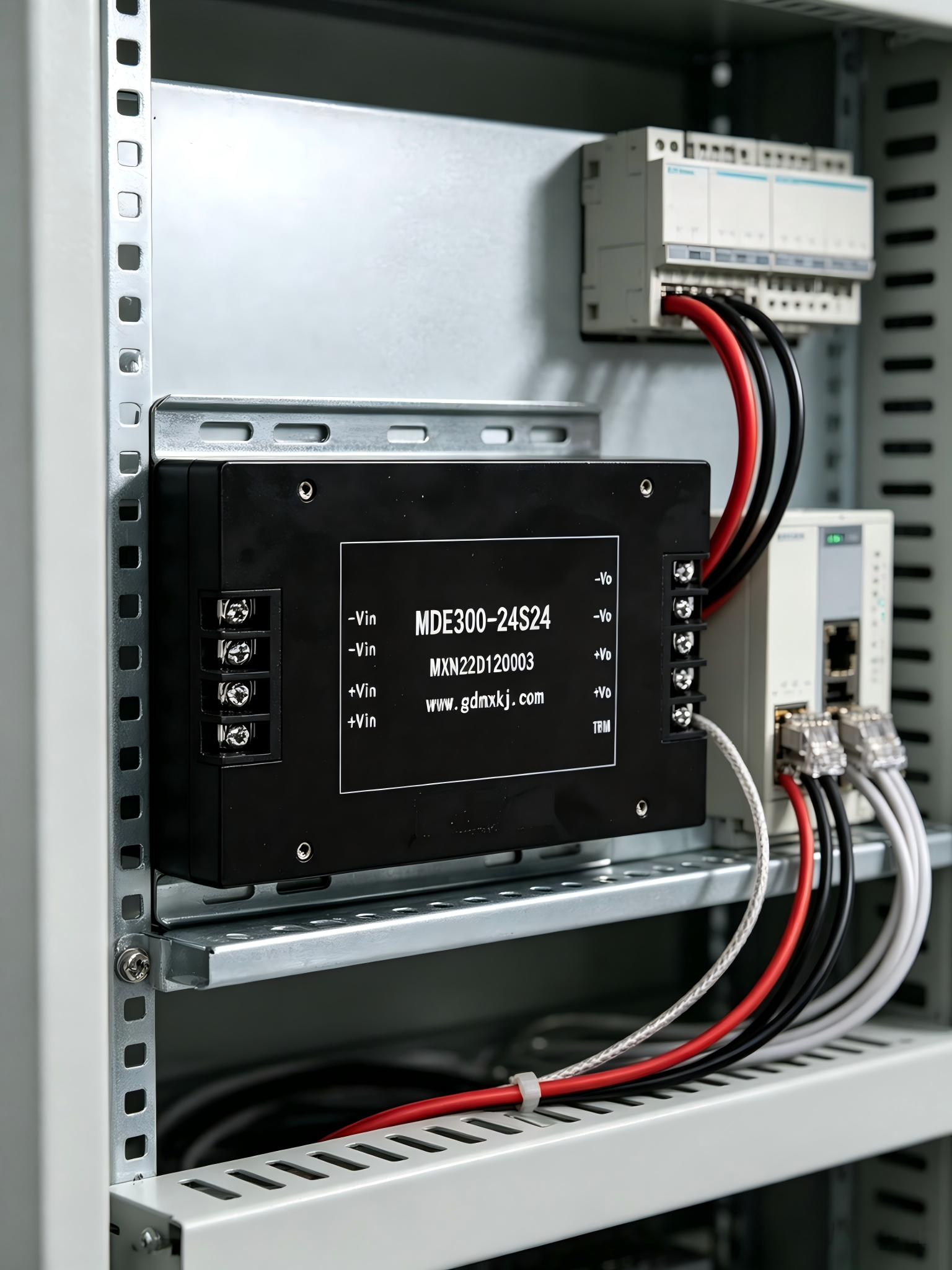
MDE300-24S24: Why Add Another DC-DC Converter When Both Sides Are 24V?
Most people's first reaction to this part is: 24V in, 24V out — isn't that redundant?
On the bench, sure. On a real factory floor, the answer is: the 24V on your bus and the 24V your sensitive loads actually want are not the same 24V.
What's "dirty" about the 24V on the bus
In a real cabinet, the 24V rail is fed from one big power supply and hangs dozens of loads off it — solenoid valves, contactors, VFDs, relay coils. Every time one of those switches, it injects spikes and sags onto the bus. Different equipment sits at different ground potentials, creating ground loops.
The bus still reads 24V on the meter — but the sensitive loads on it (industrial comms modules, precision sensors, machine vision cameras, remote IO) either throw up communication errors, drift on their readings, or in the worst case, get their chips destroyed.
The MDE300-24S24 exists to put an isolation wall between that "dirty" bus and those sensitive 24V loads.
What it actually does
It's a 300W isolated DC-DC converter: input taps the existing 24V bus (accepting a wide 18-36V range), output delivers a clean, isolated 24V rail for the back end, up to 12.5A.
Bus spikes and surges are blocked at the isolation barrier;
Input and output don't share a ground — ground loops are cut;
The output 24V is regulated: ±2% set-point accuracy, ±0.5% line/load regulation;
Ripple held under 200mV peak-to-peak;
Typical efficiency 89%, running cool even at full 300W load.
It isn't really "converting voltage" — it's conditioning it. Turning a 24V that's numerically correct but electrically noisy into one that precision loads can actually live with.
How it fails safe
Five built-in protections cover the realistic fault modes: input undervoltage, input overvoltage, over-temperature, output over-current (limited to ~120%), and output short-circuit. Under a fault the module goes into protection rather than blowing up, and recovers automatically once the fault clears — no service call needed.
Margin-wise: input-to-output isolation >1500VDC, input-to-case >1050VDC, output-to-case >500VDC, 200MΩ insulation — the kind of isolation rating accepted in industrial and rail auxiliary circuits.
Where it lives
Industrial case temperature -25°C to +85°C, with Military I (-40°C) and Military II (-55°C) options. Same MDE-series footprint: 118 × 110 × 29.5mm, pin/rail-mount, clips onto the cabinet plate. Outdoor cabinets, vehicle compartments, sealed control enclosures.
Where "same voltage, but isolation needed" comes up
Inside industrial cabinets: feed comms modules, sensors and machine vision a separate, clean, isolated 24V rail
Next to VFDs and servo drives: isolate analog and comms circuits from switching noise
Between multiple 24V loads that can't share a ground
Telecom base stations and energy storage secondaries needing a regulated, isolated 24V branch
Rail and vehicle systems: conditioning the raw 24V bus before sensitive electronics
In the MDE 100-300W lineup, the MDE300-24S24 is specifically the part for "24V-to-24V isolated regulation." Need 48V or 110V input, or 12V/48V output? The series has those too. Non-standard voltages and powers can be custom-built.
For samples and datasheets: Guangdong Mingzinc Technology, +86 400-019-3997, shturl.cc/Urdf.
#MDE300-24S24 #isolatedDCDC #24Vto24V #isolatedpowermodule #300Wpower #industrialpower #groundloop #surgeprotection #Mingzinc #powersupply