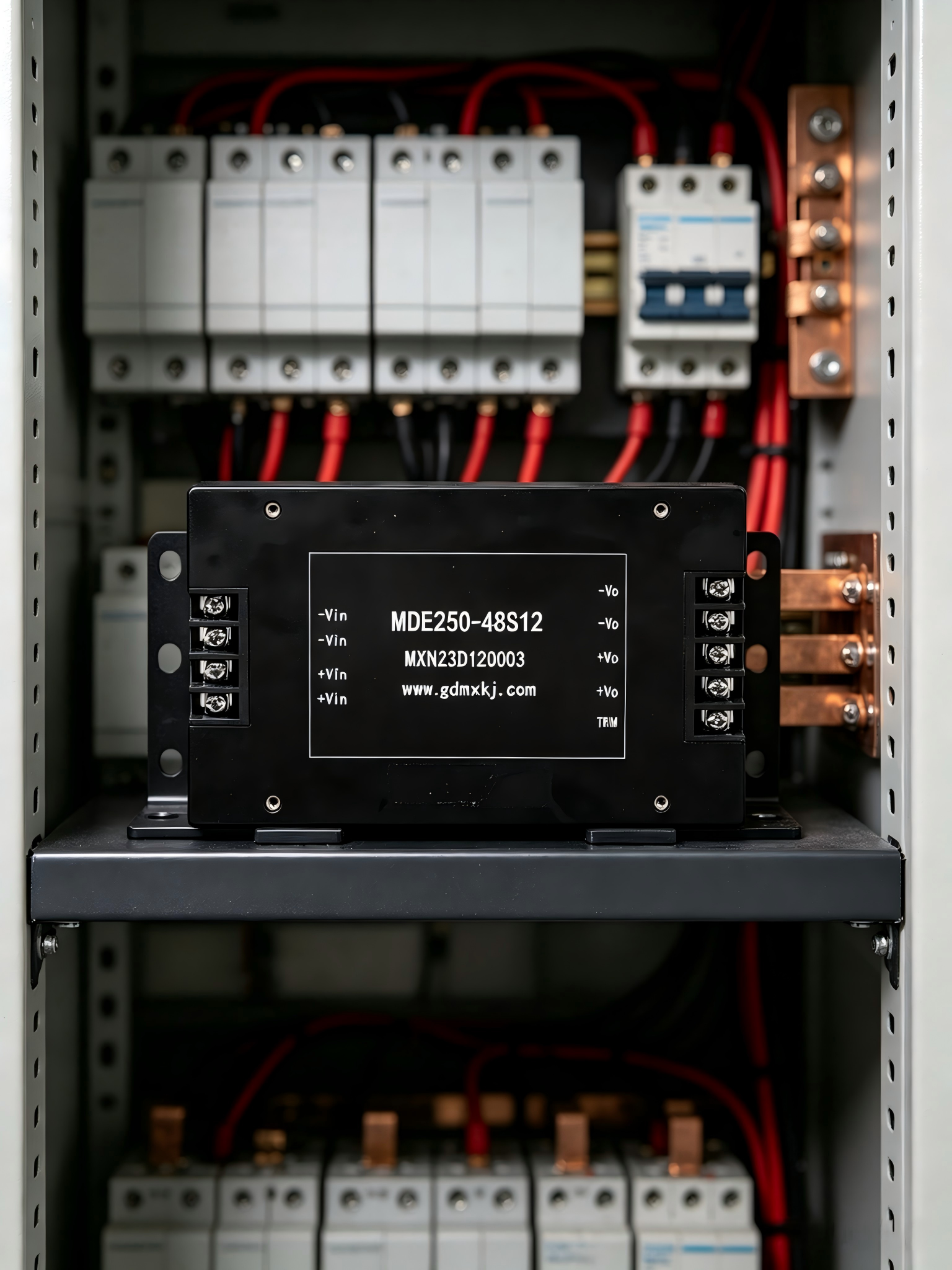
MDE250-48S12: The Bridge Between the 48V Energy Storage Bus and Your 12V Loads
Open any modern energy storage cabinet or telecom base station, and you'll see a familiar voltage split: the battery side runs at 48V, but the equipment side runs on everything but — optics modules want 12V, sensors want 12V, the comms main board wants 12V, even the fans and cabinet lighting run on 12V.
Why not just run everything off the 48V battery? Because 48V is the "bus voltage" — optimized for transmission efficiency and battery-pack standards. 12V is the "chip voltage" — it needs to be quiet, regulated and low-noise. Between those two levels sits a dedicated converter. That's exactly the job of the MDE250-48S12.
Which 48V does it accept
Rated at 48VDC, it actually works from 36 to 72VDC. That range is deliberate: a 48V LiFePO4 pack sits at 54.4V fully charged, floats between 54 and 58V, and some systems top out near 60V. The module keeps regulating all the way down to 36V (battery near empty) and up to 72V — no external protection circuitry needed.
How much 12V can it deliver
12V at up to 20.8A, a continuous 250W. That's enough headroom that every 12V rail in a comms cabinet — comms modules, acquisition units, indicator lights, fans — can be fed from this one module instead of scattering tiny supplies everywhere.
Set-point accuracy is ±2%, line and load regulation both ±0.5%, ripple just 120mV peak-to-peak. At 12V, that's a quiet enough rail that optical modules and high-speed comms chips won't throw errors from supply noise.
Why isolation is non-negotiable
Inside storage cabinets and base stations, the 48V bus shares ground with high-power circuits — when the inverter or battery contactor switches, spikes of over a hundred volts ride on the line. The MDE250-48S12 provides >1500VDC input-to-output isolation, >1050VDC input-to-case and >500VDC output-to-case. It cleanly separates the sensitive 12V electronics from the "loud" battery bus.
Efficiency is 88%; at 250W full load the self-loss is around 34W, handled by the metal case's natural convection — no extra forced-air ducting needed inside the cabinet.
The failure baseline
Five built-in protections: input undervoltage, input overvoltage, over-temperature, output over-current (120% typical limit), and output short-circuit. Under a fault the module current-limits instead of destroying itself, and recovers automatically once the fault clears. That matters for unattended base stations and outdoor storage cabinets — nobody's climbing a tower to press a reset button.
Industrial case temperature runs -25°C to +85°C, with Military I and II grades available. Footprint is the standard MDE size: 118 × 110 × 29.5mm, rail/pin-mount.
Where it belongs
Inside 48V PV storage systems: powering the BMS, comms modules and auxiliary 12V circuits
Telecom base stations and 5G remote sites: taking 12V from the -48V bus
LED display and lighting: fed from a 48V battery or PV bus
Industrial 48V systems needing a 12V branch
Any place with a 48V battery pack up front and clean 12V required downstream
In the MDE 100-300W lineup, the MDE250-48S12 is the 48V-input workhorse. Need 24V or 110V input, or 24V/48V output? The series has those. Custom voltages available.
Samples and datasheets: Guangdong Mingzinc, +86 400-019-3997, shturl.cc/Yrby.
#MDE250-48S12 #48Vto12V #isolatedDCDC #energystorage #telecompower #solarstorage #250Wpower #baseStation #Mingzinc #powersupply